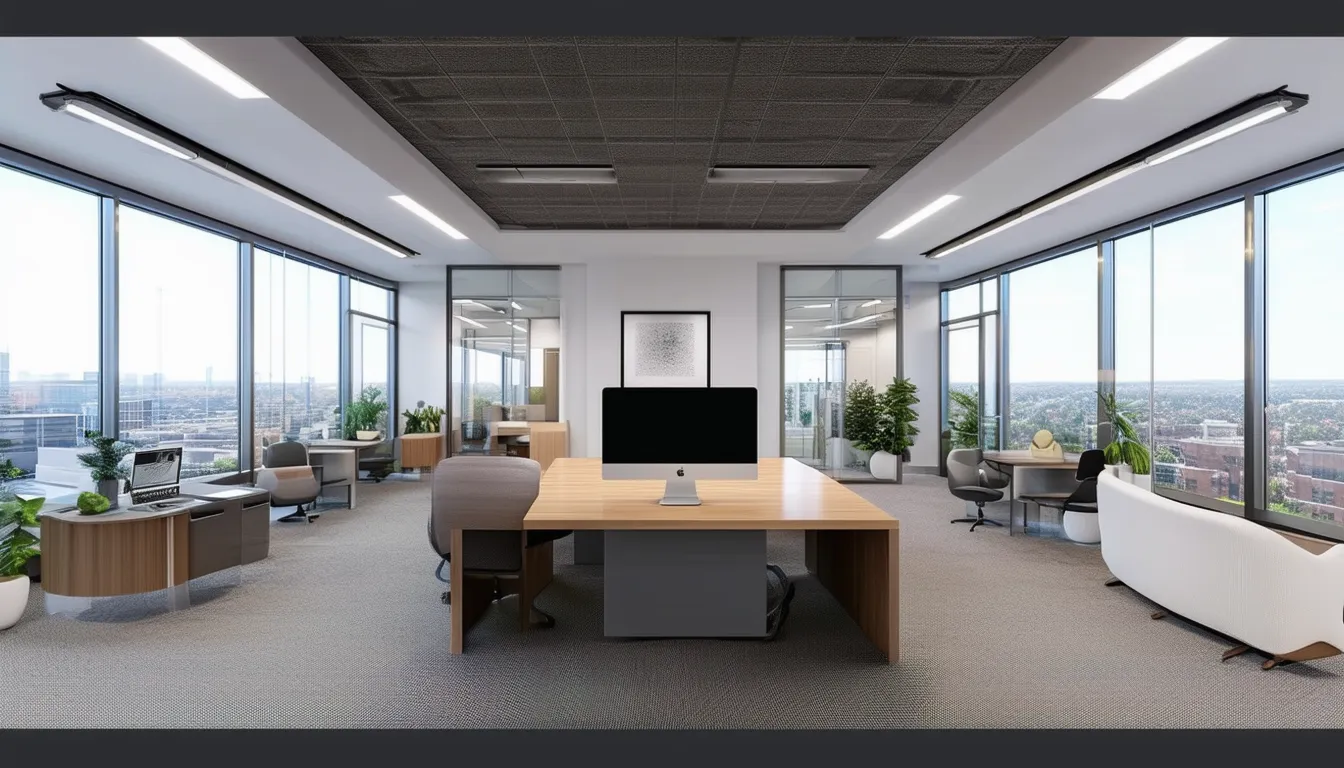
Matterport is a 3D camera and software platform that creates interactive virtual walkthroughs of real-world spaces — letting buyers explore a property room by room, from anywhere in the world. Originally launched in 2011, it’s become the industry standard for immersive real estate tours, combining 360° photography with spatial data to produce navigable 3D models, auto-generated floor plans, and dollhouse views. Here’s how it works, what it costs, and why agents across DC, Maryland, and Virginia are making it part of every listing.
That’s a fundamentally different experience. Instead of passively viewing someone else’s perspective, buyers actively explore the space. They choose where to go, what to look at, and how long to spend in each room. They zoom in on countertops, measure bedroom walls, and compare the kitchen layout to their current home — all before ever scheduling a showing.
For agents, this changes the game. Listings with 3D tours receive 95% more phone inquiries and homes sell up to 31% faster. For buyers relocating from out of state, a Matterport tour can be the deciding factor between making an offer sight-unseen or moving on to another listing.
What Is Matterport?
Matterport is a spatial data platform that creates interactive 3D digital twins of real-world spaces. Founded in 2011 and acquired by CoStar Group in 2025, it’s become the industry standard for immersive property tours in real estate, hospitality, retail, and commercial spaces.
The simplest way to understand it: imagine Google Street View, but for the inside of a building. You can navigate freely through rooms, look up, down, and all around, and get a true sense of how a space feels — its proportions, its flow, its light.
Explore one of our Matterport virtual tours to see it in action. But Matterport goes further than simple 360-degree photos. It captures actual 3D geometry — the depth, dimensions, and spatial relationships between surfaces. That data powers features that flat imagery can’t match:
- Dollhouse view — a 3D overhead perspective that shows the entire floor plan as a cutaway model
- Floor plan view — an automatically generated top-down schematic with room labels
- Measurement tools — buyers can measure any distance within the model (wall to wall, window width, ceiling height)
- Mattertags — clickable hotspots that display text, images, video, or links at specific points in the tour
- VR compatibility — the model can be experienced in virtual reality headsets for full immersion
How the Technology Works
The scanning process is straightforward:
-
On-site capture — A technician positions a Matterport-compatible 3D camera (most commonly the Matterport Pro3 or Pro2) at multiple points throughout the space. At each position, the camera rotates 360 degrees, capturing high-resolution color imagery and infrared depth data. A typical 2,000 sq ft home requires 50-80 scan positions.
-
Cloud processing — The raw data is uploaded to Matterport’s cloud platform, where AI algorithms stitch the scans together, build the 3D mesh, apply color textures, and generate the navigable model. Processing usually takes 2-4 hours.
-
Delivery — The finished tour is hosted on Matterport’s platform and accessible via a shareable link. It can be embedded on websites, shared on social media, integrated with MLS listings, and published to Google Street View.
The entire on-site scan for a standard residential property takes 30 to 60 minutes. You receive the finished, hosted tour within 24 to 48 hours.
Matterport vs. Other Virtual Tour Options
Not all virtual tours are the same. Here’s how the main options compare:
| Feature | 360 Photo Tour | Video Walkthrough | Matterport 3D Tour |
|---|---|---|---|
| User control | Click between fixed spots | None (passive viewing) | Full free navigation |
| Spatial accuracy | Low — distorted panoramas | None | True 3D geometry with measurements |
| Dollhouse view | No | No | Yes |
| Auto-generated floor plan | No | No | Yes |
| Measurement tools | No | No | Yes |
| Engagement time | 1-2 minutes | 1-3 minutes | 5-10 minutes |
| Typical cost | $100-$200 | $300-$1,500 | $150-$500 |
The key difference is depth — literally. 360 photos and video capture flat imagery from specific viewpoints. Matterport captures the actual three-dimensional structure of the space, which enables features like measurements, true-scale floor plans, and the signature dollhouse view.
That said, each format has its place. Video walkthroughs are better for emotional storytelling and social media. 360 photos work for quick, low-budget tours. Matterport is the choice when you want buyers to spend real time exploring the property and understanding its layout.
Why Matterport Tours Sell Homes Faster
Buyers Spend More Time on Your Listing
The average buyer spends 20-30 seconds looking at listing photos before moving on. With a Matterport tour, that jumps to 5-10 minutes of active exploration. More time on your listing means a deeper connection with the property — and a higher likelihood of inquiry.
This matters for portal algorithms too. Zillow, Realtor.com, and Redfin all factor engagement signals into listing visibility. A listing where buyers spend 10 minutes exploring will rank higher than one they bounce from in 30 seconds.
Remote and Out-of-State Buyers Can Make Confident Decisions
In markets like the DC, Maryland, and Virginia area, a significant percentage of buyers are relocating. They may be able to visit once — or not at all — before making an offer. A Matterport tour gives them the confidence to move forward because they’ve already “walked” the property multiple times.
This isn’t hypothetical. During the pandemic, sight-unseen offers became common, and Matterport tours were the tool that made that possible. The behavior stuck — remote buyers now expect 3D tours for any serious consideration.
Fewer Wasted Showings
When buyers explore a Matterport tour before scheduling a showing, they already know whether the layout works for them. The result:
- Showings involve more serious, pre-qualified buyers
- Fewer cancellations and no-shows
- Less disruption to sellers’ daily routines
- Higher offer-to-showing ratios
Higher Sale Prices
Redfin’s data shows listings with 3D tours sell for $6,000 to $10,000 more on average. The likely reason: buyers who’ve spent 10 minutes exploring a property develop a stronger emotional attachment than those who’ve only flipped through photos. That attachment translates to more competitive offers.
Real Estate Isn’t the Only Use Case
While residential real estate is the most common application, Matterport 3D tours create value across industries:
Hospitality and Short-Term Rentals
Hotels and Airbnb hosts use Matterport tours to reduce booking hesitation. Guests can explore the exact room, suite, or rental before committing. Properties with 3D tours see higher booking conversion rates and fewer complaints about “not matching expectations.”
Commercial Real Estate and Offices
Leasing agents use Matterport to show office spaces, retail locations, and industrial properties to prospects who may be in different cities. Tenants can evaluate layout, measure for furniture, and share the tour with decision-makers — all without scheduling a site visit.
Construction and Architecture
Matterport scans at different project stages create a visual timeline of construction progress. General contractors use this for remote client updates, dispute documentation, and coordination between trades. Architects use it for as-built documentation of existing structures before renovation.
Retail and Showrooms
Furniture stores, car dealerships, and luxury brands create virtual showroom experiences. Customers browse inventory and explore the space from home, driving more qualified foot traffic when they do visit.
DIY vs. Professional: What Makes Sense?
Matterport offers lower-cost cameras (like the $400 Matterport One) designed for DIY users. So should you scan properties yourself?
DIY makes sense if:
- You scan 10+ properties per month (the equipment investment pays off)
- You’re willing to learn proper scanning technique (camera placement, lighting, overlap)
- You have time to manage uploads, processing, and hosting
Hiring a professional makes sense if:
- You scan occasionally (the per-scan cost is lower than equipment depreciation)
- You want consistent, high-quality results without a learning curve
- You prefer to focus on selling while someone else handles the technology
- You need same-day or next-day turnaround
The equipment cost alone is significant — a Matterport Pro3 camera runs $5,000+, plus a monthly Matterport subscription ($69-$309/month depending on plan). For most agents, hiring a professional at $150-$500 per scan is the better value until volume justifies the investment.
How Much Does a Matterport Tour Cost?
Pricing depends on whether you hire a professional or do it yourself.
Hiring a professional (recommended for most agents):
- Standard residential properties (up to 5,000 sq ft): $150–$300
- Larger or luxury homes (5,000–10,000 sq ft): $300–$500
- Umedia’s 3D tour packages start at $199 — includes scanning, processing, hosting, and a shareable link
Going the DIY route:
- Matterport Pro3 camera: $5,000+ (entry-level Matterport One: ~$400)
- Matterport cloud subscription: $69–$309/month depending on plan tier (Starter, Professional, or Business)
- Your time: scanning, uploading, managing hosting
For most agents, hiring a professional is more efficient unless you’re scanning 10+ properties per month. See our full pricing page for current rates.
Is Matterport Worth It?
For most real estate agents in competitive markets, yes. Here’s the honest breakdown:
Advantages:
- Listings with 3D tours sell up to 31% faster and for $6,000–$10,000 more on average
- 95% more phone inquiries compared to listings without 3D tours
- Buyers spend 5–10x longer engaging with your listing
- Out-of-state and remote buyers can make confident decisions without visiting
- Reduces wasted showings by pre-qualifying buyer interest
- Tours work 24/7 — no scheduling required
Limitations to consider:
- Requires a hosting subscription (Matterport’s cloud platform is not free long-term)
- Tours need updating if the property undergoes significant changes
- Scan quality depends on proper staging and preparation — a cluttered home produces a cluttered tour
- Not a replacement for professional photography — best used alongside high-quality photos and video
The ROI math is simple: if a $199–$500 investment helps sell a home faster or at a higher price, it pays for itself many times over.
How to Get the Most From Your Matterport Tour
Preparation Matters
The quality of your 3D tour starts before the camera arrives:
- Stage the home as you would for professional photography — clean, decluttered, well-lit
- Open all interior doors so the scan captures continuous flow between rooms
- Turn on every light and open blinds for consistent, bright imagery
- Remove pets and people — anything that moves will create artifacts in the 3D model
- Hide personal items like family photos, medications, and valuables
Maximize Distribution
A Matterport tour that nobody sees is a wasted investment. Put it everywhere:
- MLS listing — most platforms now support embedded 3D tours or virtual tour links
- Your website — embed the tour directly on the listing page
- Social media — share the tour link with a preview image or short screen-recording clip
- Google Street View — publish the tour to Google Maps for search visibility
- Email campaigns — include the tour link in property blast emails to your buyer database
- Open house follow-up — send the tour to attendees so they can revisit the property at home
- Pair with aerial content — combine with drone photography for a complete listing marketing package
Use Mattertags Strategically
Mattertags are clickable hotspots you can place anywhere in the tour. Use them to:
- Highlight recent upgrades (“New HVAC system installed 2024”)
- Call out premium features (“Imported Italian marble countertops”)
- Link to relevant documents (disclosure forms, HOA documents, floor plans)
- Provide neighborhood context (“Award-winning elementary school — 0.3 miles”)
Don’t overdo it — 5 to 10 well-placed tags add value without cluttering the experience.
Make 3D Tours Part of Your Listing Strategy
Matterport 3D tours have moved from “nice to have” to “expected” in competitive markets. Buyers — especially those relocating or comparing multiple properties — gravitate toward listings that let them explore on their own terms.
For agents, the ROI case is straightforward: faster sales, higher prices, more qualified showings, and a professional edge that sets you apart in listing presentations.
Ready to add 3D tours to your listings? Explore Umedia’s virtual tour services or contact us for a quote.